 |
| Pieces of Antrea net |
There is a debate whether Neanderthals have or have not inhabited Finland before ice age, but we will probably never know for sure. The landscape of Finland was severely reformed by the last ice age until about 10 500 year ago. Its effect affected the nature for millenniums after the ice withdrew and in some extend even today.
Finnish Stone Age
Finland was first inhabited by hunters and gatherers soon after the end of the withdrawal of ice sheet. They may or may not be some of the ancestors of modern Finns. Yet they did not speak language that was closely related to modern Finnish.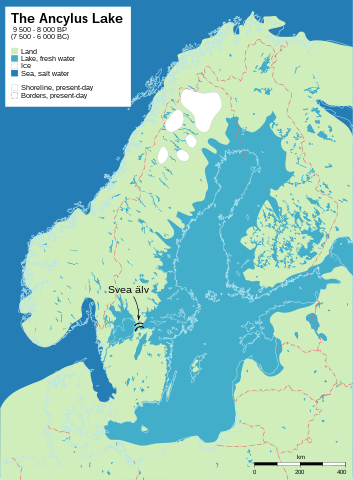 |
| Ancylus Lake, design by Koyos (PD) |
The oldest known dwelling in Finland are goahti (hut/tent/tipe) types of buildings from the era of Suomusjärvi culture. They were most likely covered with either leather or birch bark.
Neolithic culture arrived to Finland around 5000 BCE. Buckwheat was first cultivated around 5300 BCE, but the cultural change followed only around 5100 BCE with the new Comb Ceramic Culture. This new culture was spread along the coast line of Anculys Lake (modern Baltic sea). After 4000 BCE climate started to cool down towards the modern temperatures.
While people knew agriculture and ceramics, they were still mainly hunters and gatherers. They hunted especially moose, beaver and seals. Humans followed the game's movement with seasons. During neolithic era people living in Finland painted plenty of rock painting that have been interpreted to have had relationship with shamanistic world view. People bought flint stone from south. They used bows and arrows.
 |
| Kierikki ceramic around 3500-3200 BCE. Photo by Bluefinland (Wikipedia, PD) |
Corded Ware Culture spread to Finland from south around 3200-2900 BCE, which later spread to the area from modern Belarus to around Baltic sea. It was known for its stone axes that copied the style of copper ones. The culture was known for its habit of burying deceased to the single graves, men on their left and women on their right side.
In Finland there might have been conflict between Corded Ware and Comb Ceramic culture, when Corded Ware culture spread around the coastal area. The new people started to build huts, while people before had used tee pee type leather shelters. They may have brought cattle along them.
During the Corded Ware era the building were located little further from the coast than before, behind the coastal meadows. They were located so the feed for the cattle was close by. During the Kiukais Era the houses returned to the coast line.
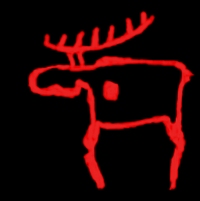 |
| Rock painting from Astuvansalmi. |
People certainly knew agriculture well. At least wheat, barley and oats were known. While the hunting and gathering was still very important, the slash-and-burn agriculture spread fast western and southern areas. The main livelihood was most likely fishing.
During the stone age people were mostly self-sufficient, but important tools and material were traded. The northern schist and eastern soapstone spread to the whole area. Flint was mainly imported from Russian, but southern Scandinavia as well. The chisels made of green shcist from Lake Onega area and knives and points made of Scandinavian red shcist were imported as ready-made tools. The asbestos from Savo area was traded during the manufacture of asbestos-ceramics.
Amber was imported from west and east. There has been also sembra wood ladles and runners found, most likely from Ural area. During the Corded Ware the internal trade was popular as well. The ceramics were made to trade and stone axes made of western Finnish olivine diabase spread to the whole area.
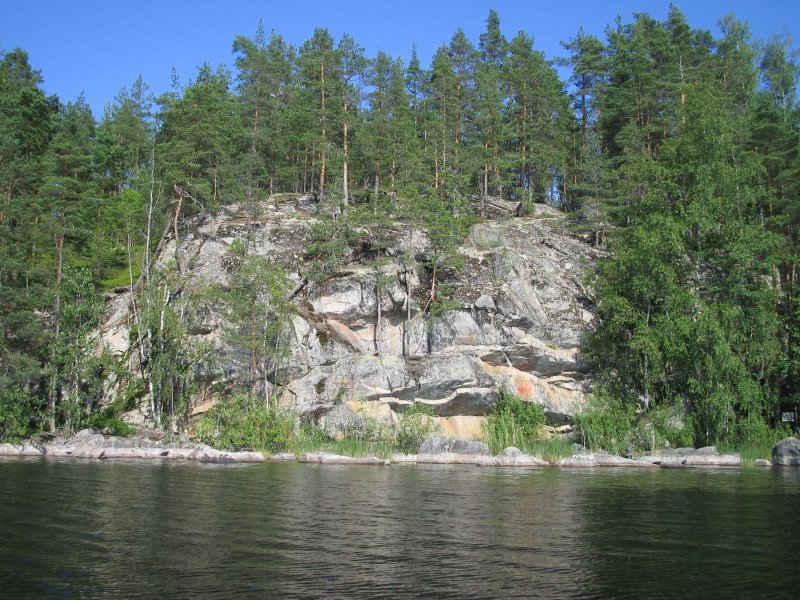 |
| Many rock painting in Finland were made so they could only be reached from boat or ice. Photo by Lauri Kokkonen (PD). |
The sledges are one of the oldest findings in Finland and were used from the beginning of the stone age, probably pulled by dogs. The oldest skis found are from Comb Ceramic era. Earlies beautiful stone sculpture animal heads (f.e. moose and bear) date also from Comb Ceramic era. Ceramic, wooden and amber idols were known as well, although less fine quality.
Early Metal Ages
Finnish early metal age was around 1500 BCE - 200 CE. Around this era metal were known, the stone was still common material for everyday tools. There were two different cultures in coastal and inland areas.Bronze was known from around 1500 BCE. In the beginning, the4 main influences came from east. People knew how to make bronze, but most of the metal artifacts were brought from abroad. They were expensive and a sign of wealth. Only 150 metal artefacts have been found from Finland from this era. There were several different styles of ceramics known during the bronze age. Deceased were cremated and buried under stone piles.
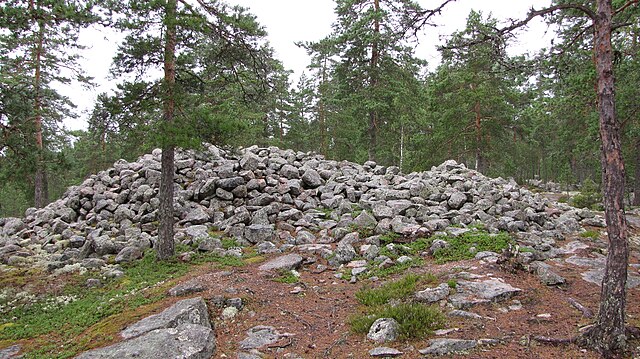 |
| Bronze age burial site in Sammallahdenmäki, Southwestern Finland, UNESCO as a World Heritage Site. Photo by Roquai (PD, Wikimedia) |
The culture was split in the western and eastern groups. In the west, the agriculture gained more significance, although hunting and gathering was still important. Most of the agriculture was still slash and burn. Cows, pigs, lamb and goats were kept and barley and wheat cultivated. The long houses were built like in Scandinavia. They were made between post and the walls might have been covered with either reed or turf. The houses might have been divided in two with the cattle in the other end. The floor might have been covered with flat stones.
In the east, the hunting and gathering was the main livelihood. Some barley was cultivated as side living. The main settlements were located along the water ways with good connections. Some were used for centuries from stone age to iron age. The housing might have been similar to the late stone age. Bronze casting was known, although most metal artefacts were imported. People had connected to the areas of Finno-Ugric populations in the East along the Volga and Oka rivers.
.jpg/640px-Grave_from_the_Bronze_Age_in_Helsinki_(Pronssikausi_hauta).jpg) |
| Some bronze age graves were looking for the Sea. Photo by Pöllö - CC-BY-3.0 |
The first iron artifact arrived to Finland around 800-400 BCE. They came from both Scandinavian and Baltic areas and from northern Russian Ananjino Culture. People started to make iron artifacts both in the coastal and southern inland areas around 500-300 BCE. In the northern areas the iron making started around 300-200 BCE. The iron use is supposed to have spread slowly.
The earliest iron age in Finland is known as pre-Roman around 500 - 0 BCE. The iron was made from limonite found in lakes and bogs. In the coastal areas, the livelihood was based on seal hunting, fishing and agriculture. The graves were more modest than during bronze age. The coastal area was well connected to south to the Baltic area.
Upright pole based buildings were common during the whole iron age. The building was constructed between upright poles there were horizontally twined branches or split wood. The walls were clayed. Fireplace was in the middle of the floor. The outer walls might have been covered with turf.
 |
| Roman coins like this have been found also in Finland. CC BY-ND 4.0 by Turun Museokeskus |
Burials in Southern Finland resembled the Estonian and Baltic ones, while the ones on the southwest coast were more like eastern Swedish. In the Ostrobothnia or mid- and northwest coastal area the old burial practices that had roots in the bronze age continued.
Later Roman Iron Age was in Finland around 200-400 CE. While the Roman power weakened, it was still important influence. In Finland in the Southern and South-Western coastal areas the metal objects were buried with deceased. In the coastal areas people were connected to both Baltic areas and Scandinavia as well as Finno-Ugric people in the mid-Russia. The rich burials tell about the birth of the class division. There was clearly a kind of upper class.
Middle and Late Iron Age
In the middle-Iron age the Roman power vanished. In the Migration Period of Europe (400-550/600) the agriculture spread from the coastal areas inward. There was more and more metal artefact in the graves and the weaponry resembled the ones of Germanic people. The Baltic style of jewelry is still well known. The oldest horse bit found in Finland are from this era. The first signs of cats are from middle-iron age as well. |
| Viking age building remake from Rosala Photo by Pöllö - CC-BY-3.0 |
During the Meroving period of Finnish iron age (550/600-800) vivid local culture is seen. There are a lot of archeological finds in south- and mid-western coastal area as well in the northern Häme area (Tavastia) called Pirkanmaa. The finest weapons were still imports. Jewelry was influenced from abroad, but locally modified to the taste. The local smithy was skillful. The foreign connections to Scandinavia, Western-Europe, Baltics and Finno-Ugric people in Russia, especially Permians were active. In the south-west and west coast agriculture was main source of livelihood, but in the inland areas the hunting and gathering was still important and fur trade might have been source of extra income.
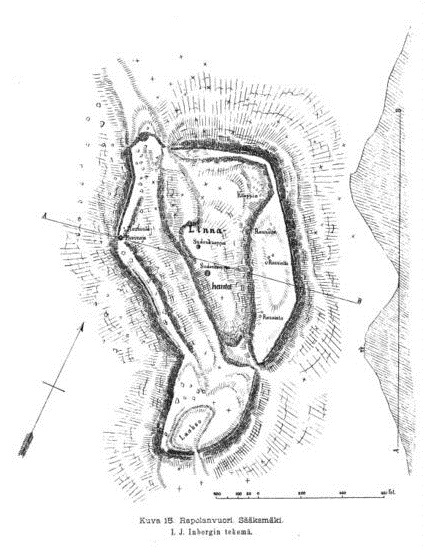 |
| Rapola hill forth is one of the mightiest in Finland. |
There is one mysterious burial site found from Leväluhta Southern Ostrobotnia were women and children (but no men) were possibly buried in the lake before it formed a bog. It differs from other bog burials as there are no signs of sacrificial violence. Animal bones were found and are supposed to be from provisions to the afterlife. Valuable crave gifts have also been found. The cremation usual to the era was not used.
In the younger iron age the new type of building, the log construction became common, although the roots of this building method were in the bronze age. The method of laying logs at intervals was used to make airtight buildings. In this era, the oven was placed on the corner of the building. The houses were covered with reed, straw, rods, birch bark or turf. The smoke was led out from the small hatch in the roof.
The Viking Era of iron age (800-1025/1050) was time of vivid foreign trade in Baltic Sea area. Early town like settlements were formed in many areas and silver was plenty. In the Viking era the demand of fur in Europe grew which brought new wealth to the area.
 |
| Karelian brooch from Iron age. Similar horseshoe brooches were well known in Finland during Viking and Crusade eras. |
The population grew especially in the Savo and Carelian areas in the Eastern Finland. At the same time, it vanished from Ostrobotnia and Uusimaa areas in west and south coast for unknown reasons. It is possible that the coastal people moved inlands to protect themselves from the Viking attacks. In the same era, a lot of new village size hill forts were built. Few runestones found in Sweden tell Viking travels to Finland as well. Forntjot saga tells stories of Finnish and Kvenland kings, where the Kvenland is sometimes interpreted as Kainuu or Nothern Ostrobotnia, although they may tell about Sami people as well.
The first good evidence of clothing from Finland is from the Viking Era, although there are some scraps of fabric from the early iron age onward. The popular bronze spiral decorations in the clothing helped to save evidence in the graves. The popular bronze jewelry helped with the preservation of the fabrics as well. The main materials were wool and linen, although hemp and nettle was used as well. There are signs of imported fabrics like silk and Frisian broadcloth.
 |
| Typical vaulted bronze brooch from Viking Era. CC-BY-ND 4.0 Mikkelin kaupungin museot |
The Crusade Era of iron age (1025-1300) the surrounding areas had mostly converted to cristianity.
During this era, the Scandinavian kingdoms were greedy for the influence in the east, where Novgrod was growing as the center of trade. In the center of this political contest was the Eastern Baltic sea area including Finland, Karelia and the Baltic countries.
The population grew, especially in Karelia and the agriculture was strong. The burials became immaterial ones. Finland was in the middle of the clash between eastern and western churches, that had split just 1054. Because of the unstable environment the hill forts became more and more important. New ones were build and old ones re-equipped. In the 12th century the first churches were built in the southwestern Finland.
Arrival of Christianity
 |
| 12th century dress remake from Western Finland. Photo by Daderot CC0 / PD |
Change in burial customs around year 1000 were the clear sign of strong Christian influences. Also grave gifts vanished around the same time. Already during the Viking era Finns had started to bury deceased facing Easter sunrise. Around year 1000 most craves in south-western Finnish graveyards in Eura and Köyliä area faced the Easter sunrise, although the pagan believes are still seen living alongside new Christian ones.
Bishop Hilthius might have been missionary bishop in Birka in 11th century and responsible for Finnish mission. His responsibility were the Christians living east of Sweden. In the 11th century at least parishes of Kalanti and Laitila likely belonged to western church. Officially Christianity arrived to Finland in 12th century.
Old legends tell that Christianity would have arrived to Finland by three crusades from Sweden. The first crusade was around 1150. The second most likely 1238 or 1239. The third and possibly the only real crusade was made to Carelia 1293. The Danish made at least two crusades to Finland around year 1200. Norwegians and Germans might have made their own crusades in the 13th century as well. The evidences of many of these crusades are lacking.
 |
| 12th century dress from Eastern Finland. |
The Second Crusade might have been the first occupation of Finland by Swedes. According the Chronicle of the Lybeck Birger Jarl forced Finland to belong to Sweden. It was not a real crusade either, but more like a leidang-excursion. The excursion was directed to Tavastia also known as Häme, maybe to the harbor of Rikala, a coastal center or town in former Halikko municipality. The Chronicle of Erik that tells the story has been later seen as a political propaganda.
The Third Crusade 1293 was also described in the Eric Chronicles (written between 1320-1335). Duke Eric Magnusson, the hero of the chronicle and the brother of the king of Sweden, was the leader of the third crusade against Karelians. The motive was supposed to be the lootings by Karelians. The real motive was probably to conquer the area and gain an important trade post. The Castle of Vyperg was soon build as a strong hold in the site of former Karelian fortress.
Links to the Resources of Finnish History:
- Wikipedia: History of Finland
- This is Finland: MAIN OUTLINES OF FINNISH HISTORY
- Information about Finland: Finnish History
- Lonely Planet: Finland: History
- Local Histories: A Short History of Finland
- The Animated History of Finland
- History of Finland: Primary Documents
- History of Finland: A selection of events and documents

I have always been interested in history. The history of our country, the history of other states and also wars, battles and the Holocaust. I even worked with a group on numismatics, we looked for old antique coins, uniforms of soldiers and sometimes we found corpses of soldiers. It didn’t bring much money, and I began to earn money on games and poker with enthusiasm https://richpalms.com/games/poker/ and I can say that a hobby is cool, and when a hobby brings money on the day, like many people have a month, it becomes just a second life. I really like and very motivate what happens, that it is easy to win and then live with money for a long time.
VastaaPoista