tiistai 5. syyskuuta 2017

Short History of Finland II: Middle Ages

Medieval Finland was still a land in the far-far north few had visited. The foreigners were mainly German merchants, Swedish officials or Dominican or Franciscan monks and priests. The trade went mainly through Stockholm. The life outside the few towns was similar than during the pagan era, although church spread its influence efficiently to the remote districts as well.

Importance of the waterways in the north
can be seen in this old map from the year 1544.
Finnish Middle ages began in the 11th and 12th centuries, when Finland slowly moved from pagan to Christian era. In the Karelia, the medieval era began around year 1300. The Finnish medieval era has been usually considered to have ended in the early 16th century. There are only about 300 written documents from Finnish middle ages and that is why archaeology is so important part of the research. Medieval era did not reach at all to the north most Finland (Lapland), where the historical era only began in 16th century.

In the early middle ages, Finland - or Eastland as it was first known - was a frontier land in many ways. There were few good roads and waterways were important passages. Most of the settlements were situated along these routes. It was waste land, where Swedes sent their convicted felons.  It was - as it would be for centuries - a borderland between eastern and western European influence.

In the beginning of medieval era the Finland covered only what is now the southern and western parts of the modern country. The areas in the north were not densely inhabited and many were old hunting grounds of the Sami people as well as the Finns.

Original treaty of Nöteborg.
Finland was originally the name of the area in the southwestern corner of the country, that is now known as Finland Proper (Varsinais-Suomi). Most of the country was situated in the area, where the western Finnish culture is prominent. The eastern Finnish culture was prominent in the area, which was then under the Novgorod rule. Yet the influence of the outer powers was not the only difference, as there was older linguistic divide as well, that has under the centuries waned, especially during the 19th and 20th centuries. Due to different outer influences the cultures also developed to the different directions.

Yet the divide was not always the same, as some of the eastern Finns belong to the orthodox church and some used to be catholic. This was partly due to the border fluctuation between east and west.


The earlies and wildest era of the Finnish Middle-ages, so called crusade era, ended with the treaty of Nöteborg (Pähkinäsaari or Orekshovests) in august 1323. It was the first border settlement between Sweden and Novgorod. Three years later Novgorod made peace with Norwegians as well. The treaty was negotiated with the help of Hanseatic merchants (from Germany). The first border stretched from east by the Vyborg castle and ended near the Pyhäjoki river in the Gulf of Bothnia. The Finnic tribes, whose lands the new treaty split, had not been . 
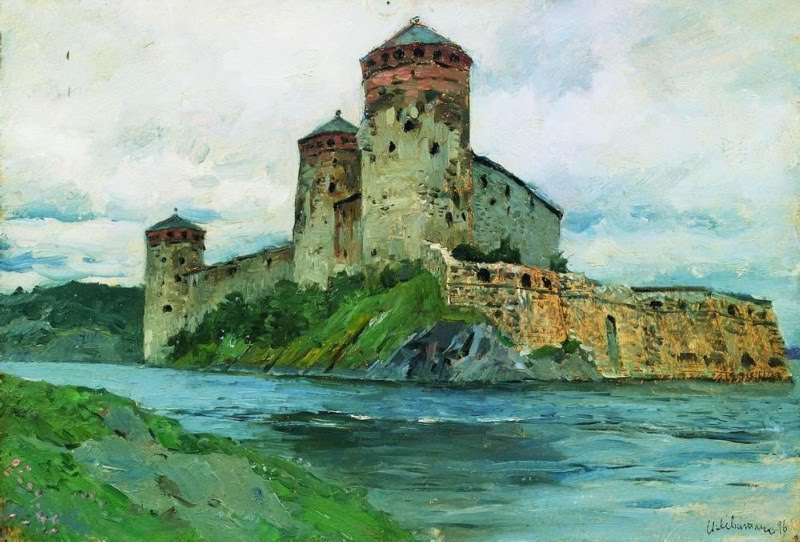
Olaf's castle (Olavinlinna) was founded 1475.

The treaty did not hinder the Swedish expansion for 
long . They spread their influences to the northern common areas, that were originally considered both Swedish and Novgorodian. The most of the border area was wilderness in the 14th century and border was not clearly marked. Swedes also misinterpreted the area the Olaf's castle (Olofsborg, Olavinlinna) was later built, to belong to the common area as well. The castle itself was built only in the end of 15th century, but Sweden had then already successfully colonized the area.

Kalmar Union was formed first in 1397. It included Scandinavian countries and their possessions. The participants of the Union retained their own laws. During the Union, the aristocrats were not very interested in Finnish issues and many things were in fact locally governed and the Union had very little influence on local politics. Most of the decision of the Union were made in Denmark, where there was not much interest in Finnish matters.

During the Union, there were conflict of interest between Denmark and Sweden, as Danish were interested in Hansa Union and Swedes in Russian matters. The Swedes tried to split out of the Union 1412 after Margaret I death. During 15th century the Swedes repeatedly tried to broke the Union. The Union finally broke up 1523, when Gustaf Vasa came to power in Sweden.

In medieval era - as well as later - Sweden was governed by an elected king and the council of aristocracy. Occasionally the meeting of the four estates - nobility, clergy, merchants and peasants - could be called together in diet (Riksdag) to make approve new laws or taxes.

Battle between Swedes and Russian according
Olaus Magnus1539
Even before the Christian and historical era, there was a tradition of folk meetings - called in Scandinavia ting (and in Finland käräjät) were local issues were decided and judgements for the wrongdoers decided. Similar meeting either in both local and province level continued through medieval era. Province level meetings were also meetings of the four estates. Provincial government was formed in 1320s and 1330s in Finland, but they were active only to early 15th century. After that provincial government was replace by kings' castle province administration and parish level meetings.

Local parish (fin: pitäjä, sv: socken - as local governance) was a basic unit of local governance and parish meetings made decision on local issues and gave judgements in minor offences. During the medieval era, there were about 100 parishes (fin: seurakunta - as religious institution) in Finland. The name 'pitäjä' may come from the Finnish pagan era locally communities, who managed the law keeping (with meetings called käräjät), religious feasts and occasionally hill forts. At least name is originally Finnish and does not come from Swedish like most other governmental terms.

During provincial meetings, a lawspeaker (lagman (sv) - laamanni (fin)) explained the legal issues to the participants. They were important officials, who little later acted as judges as well. The first signs of this institution in Finland are from year 1324. In 15th century Finland was split in two lagsman districts (lagsagla (sv) - laamannikunta (fin)), northern and southern. Third district was formed in Karelia later in the 15th century.

Medieval Towns and Centers

The high and late middle ages were time of urbanization in Europe. In Finland, most new towns were small, but Aboa (latin name of Turku (market town) or Åbo (river settlement)) was important local center. The town was born around the year 1200, which makes it the oldest modern city in Finland. It was also the largest with about 2500 inhabitants. Around this time the castle was built. In the year 1229 the Bishop of Finland was moved from Nousiainen to Koroinen, where the first bishops house and church were built in 1229. It is situated about 2 km from modern center. There had been older, iron age commercial centers before, but many of them lost their importance after Christianisation.

The oldest known map of Turku (1634). The cathedral
is situated on the right side of the river.
The other old towns born in early Medieval era were Porvoo (Borgå officially town from year 1380) built beside old iron age hill fort, Ulvila (Ulvsby) (officially town from year 1365) built in the old market place and Vyborg, old Karelian center from 11-12th centuries (1293/1403). All three towns were built in or near the delta of a large river.

The first church was built in Ulvila in the 13th century and beside the church was a trading post. There were some German merchants in town. According the archaeological finds Viborg was Karelian trade post as early as on the 10th century. It had up to 2000 inhabitants during the medieval era. It had more freedoms than the western towns. It was only Finnish town enclosed by walls. Porvoo had a hill fort already in the 9th or 10th century, but medieval settlement was from 13th or 14th centuries. The first wooden church was built in the 13th century. First stone church replaced it in 15th century and it was later expanded. Both Ulvila and Porvoo got their town rights in 1340s. They had with Rauma about 1000 inhabitants each.

Later medieval towns were Rauma (1442) and Naantali (Nådendal 1442). Rauma was located nearby the former iron age centers. There was Franciscan monastery from 15th century and their influenced reached far in the inland to Hame and Ostrobothnia as well. The harbour was originally beside the center. Naantali was built around the Brigittine nunnery (founded in 1438). It was the center of needlecrafts and important destination of pilgrimage. Naantali was the smallest of the medieval towns with only 200-300 inhabitants.

Medieval Swedish silver coin
(14th-15th century)
The number of towns was limited by the government, but likely no more would have been needed. Inland had no cities, because the connections were not good, although the medieval Häme Castle (built around 1300) was connected to Turku with Oxen Road, so called Hämeen Härkätie. The original 13th century fortification was probably located to nearby Hakoinen.

The German merchant were well established in medieval Finish towns and commercial centers. They ruled the commerce and local councils. The towns had privileges, including self-governance, courts and exclusive right to commerce and crafts. Monasteries were usually located in the towns or as in the case of Naantali, the town crew around them. Dominican monks (1249) resided in Turku; Franciscans in Åland, Rauma and Viborg. The wealthy Naantali monastery was for Brigittine nuns. There might have been nunnery for St Anna in Turku as well. There were also a Cathedral Schools in Turku (1276) and Viborg (16th century) educating priests and officials.

Most important import was salt. Hops, wine and woollen fabrics were imported as well. In the years of bad crops also grains needed to be imported. Exports were mainly pelts, dried fish and train oil (seal fat). Normally foreign and Swedish trade were handled by towns, the peasants could sail directly to Stockholm. Nobility could own the ships and did not always follow the rules either. Tallinn ruled the Russian trade.

While officially peasants should have treaded just with their nearest town, in practice Finnish peasants living near the coast traded independently abroad until early 20th century. Different regions had different orientations of trade. Western Finland was oriented towards Stockholm, where as Uusimaa, Karelia and Southern Häme was oriented towards Tallinn and Livonia. Occasionally trade reached further, towards Hansa towns in like Stralsund and Danzig (modern Gdańsk). Also westcoast towns were more like satellites of Turku and Stockholm, while Porvoo and Viborg frecuently traded with Tallinn.

Houses of Turku a lot like the late Medieval type,
only with larger windows and better chimneys.
Luostarinmäen museo by Volker von Bonin, NBA. CC-BY-4.0
In towns, as well as in country, people had animals like horses, cows, goats, hens and pigs and often a small piece of field to grow some plants or keep their cattle on. Peasants arrived to the cities during the market days to bring their produce, which helped the feed the cities. There were only open gutters in the streets, where people threw their sewage. Rubbish heaps were common. Outhouses and saunas were could be used as well. There were both private and public saunas. Bordellos could have been related to public saunas. Latrines were first built in castles during 13th century. From excavations of medieval Turku some wooden outhouses have been found. In the 17th century, every town house had to have outhouse. Although most town houses had outhouses, public conveniences were non-existent.

Towns had no official plans, but they grew organically when new place was needed. Many streets were not pawed, but some were repeatedly covered with layers of wood or branches to make them drier or more passable. In smaller town like Porvoo, there were not necessary any paved streets. Most houses had gables towards the street and doors on the street side. The houses were made log and they were "smoke cottages" (savupirtti, description later) like in the country. The houses might have been covered with peat and grass, on which goats might have grazed.

In the 15th century better double-room buildings ("pari-tupa") were begun to be built in wealthy households. Sides were built towards the street. Doors were in the middle of the long sides and inside there were two rooms in both sides of the hallway. Many houses begun to have stone foundations and small glass windows. Prober stoves were built with mortar and primitive chimneys or smoke tubes guided the smoke outside. In the 16th century, this new type of building became to be more common.

Raseborg castle 1500.
Medieval town halls were meeting places of the town councils. There were chest with town money, town archive and maybe a cell to hold suspects before they could be judged. Usually punishments were either bodily or monetary as well as dishonourings and driving criminal away from town or district. Sometimes if serious crimes were judged, the condemned could be executed.

In Turku, there were stone and brick houses as well that could have several floors. Only nobility or wealthiest of merchants could built these houses. Many of them had long side towards the street. On the other side of the house there was hidden courtyard. Houses could have had wooden roofs. No houses have been preserved from medieval era. Kastelholma was built with stones from church buildings of Turku and later others knocked medieval houses down for their own purpose. Many medieval town also burned down repeatedly. Big Fire of Turku in the early 19th century almost totally burned down the town and after it, new town plan was made and the medieval town plan vanished. Latrines have been found from medieval Turku and both wooden and stone houses could have had wooden drains as well.

There were a lot of castles and fortifications built in Finland during the medieval era. Besides the castle of Turku and Häme and Olav's Castle in the east there were other important fortifications as well. The bishops of Finland had their own castle in Kuusisto near the town of Kaarina. It was found in the end of 13th or in the beginning of 14th century. It lost its importance along the catholic church.

Viborg Cathedral (1642)
Kastelhom in Åland was built in the 14th century. Its heyday was in 15-16th century. The first mention of Raseborg castle is from the year 1378 and it was most likely build in the previous years. Its main end was to protect Swedish interests against Hanseatic city of Tallinn. Both Swedish and Danish forces battle of its control and even pirates tried to rule it. The castle was abandoned few years before Helsinki was found for the same purpose. There were some other minor castles and fortifications in important places, but many of them were already pulled down during the middle ages, some as early as in the late 14th century. Some of the fortifications might have been mainly log-structures like Korsholma, near the Vasa.

Churches were also important centers of power. 80 stone churches have survived from medieval era. Many of the churches were built in the former sacred places of pagan religion. The oldest ones were built in Åland Islands during 12th century. The churches in the Proper Finland are mainly from 14th century. Some of the remains contain only the vestry built inside or beside the wooden church. For example, in Häme province there were total of 7 surviving vestries. Many of them are from the end of the medieval era. No wooden medieval churches have survived, like in Norway. The church was the base of municipalities and spread its influence to the rural areas much more efficiently than state.

Shape of the medieval church were square and roofs were steep. First churches even in towns could have been wooden. Stone churches could also be made larger. There were special patterns of bridge building used during the medieval era.


Village Life

Many villages in Finland are from medieval era or from late iron age, some even older. Although the buildings are later, the settlements and residents are older. Sometimes the same farm or estate has been in family for centuries. Many villages changed a lot in 18th century partitions of land. Life in the medieval Finland was different than in Central and West Europe.

Even after the troubled crusade era, security was moderate at best. Finns were captured along Karelians and Baltic people and sold in the Volgan and Crimean slave markets. The slave traders reached as far as Lapland. The last raid in southern coast of Finland happened in mid-16th century.

Old Fashioned 'kiuas' oven still built in some smoke saunas.
Photo by Yves Lemarcheix. PD
From 14th century onward Western Finnish village fields were divided in the strips of land, like in many other open-field systems in Europe. Yet Finnish peasants were not bonded by land, but mostly independent land owners. There was no system of serfdom in medieval Finland. Larger estates could have could have maids and farm hands. Only in the 17th century a form of tenant farming, where the rent was usually paid with rent service. Even then the laborers were usually not bonded for longer than a year of time.

Although Finnish peasants were freemen, who owned their farms, they had very little political power on state level. On local level they participated in local councils and had little more responsibility and significance.

In Western Finland, the birth rate rose during 13th and 14th centuries, most likely because the church did not allow the abandonment of the children. Because the old village could only support certain level of inhabitants, the new settlements outside the old village were made in the former hunting grounds. In some places the number of villages could eightfold during medieval era. But then village were also abandoned during medieval era and especially just after middle ages during the years 1570-1630 during the great abandonment. Usually abandonment was due to various crisis. 

The later type of smoke cottage
In Eastern Finland, the agriculture was for long the slash-burn type. Field was more plotted than striped. People lived with their extended families, brothers together. This family type was common in Eastern Europe and  in many parts of Asia. The family type westernised as late as in 18th century. The last to split their families were independent peasants in the slash-burn region of Savo.

In both Eastern and Western parts of the country were log houses, that had no chimney. They were called smoke cottages ('savupirtti' or 'savutupa). During the medieval era, only castles had smokeless rooms in Finland. The chimneys were built in farm houses after the bricks became well available after the peasants started to make bricks first in the 16th century and in the western Finland a lot of people built chimneys during 16th century. While the house type started to change soon after medieval era, the last of this kind of houses were used in most remote districts still in 1950s. 

There were two phases of this building type. The older one (savupirtti) did have similar stone ovens (kiuas) that were used later in the smoke saunas. It was basically a square pile of stones with fireplace in the center. In front of the fireplace was the heart were the cooking was made. Originally people used clay pots to cook. In the summer time, outside huts were used for cooking. In many times the only source of daylight was the small opening in the wall meant for smoke. While this type of the building was heated, the door must have been open as well, to let the smoke out. There could be some serious draught in the winter time and smoke could harm eyes as well. The buildings were usually square shape. The lowest logs were laid on the ground, without foundations. 
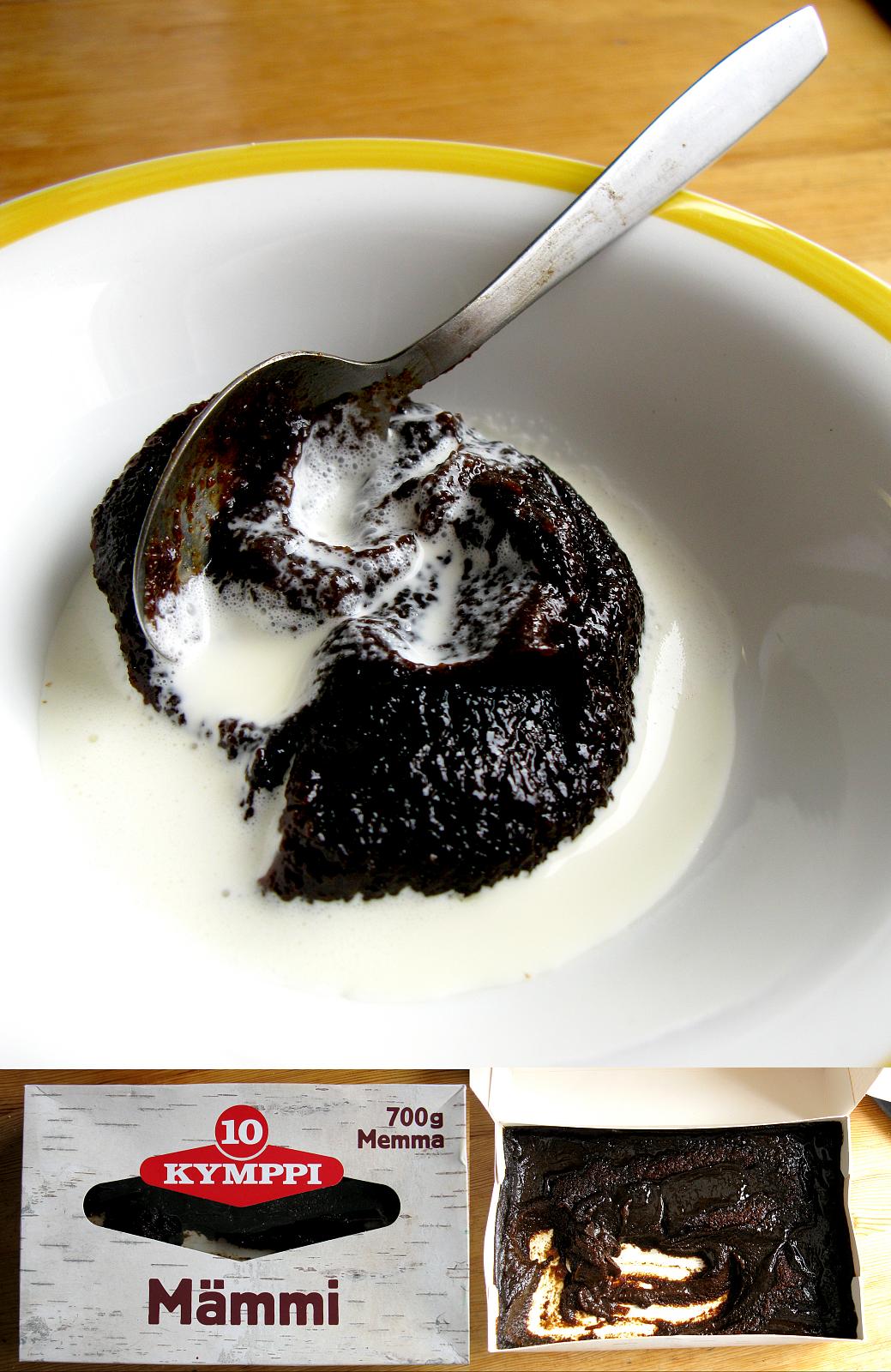
Mämmi is made is made with typical
sweetening process and is said to
have its roots in medieval era.
Photo by Martin Terber CC-BY-2.0
The later (savutupa) first became popular in 13th century. The smoke often accumulated high in the ceiling and was not so displeasing. The opening was now in the ceiling. The better stone ovens were built with mortar. Most of the new parsonages build in the early medieval era were of this type. The wall opening could also be covered with pig bladder, which let some light in. The houses were bigger in eastern Finland, where the families were peasants, because they were extended.

Because other buildings were not heated, animals might have stayed on the other end of the house, especially during intense cold. Were there was not slash-and-burn agriculture, each field was left fallow every second year. In the country, people usually relieved on the edge of the field and so the faeces were well utilized. Only in the 16th century separate outhouses began to be built and even after that they were only popularized slowly.

In the country, people lived in natural economy. Families were highly self-sufficient, although metallic tools and salt might have been bought. Only few percent of population lived in the cities. Food was mainly sourced from forests, waters and fields. Even taxes were mainly paid in form of food.

There were many methods of cooking food during Middle Ages and many of them are still in daily use. Food was usually served in single pot and eaten either directly of there or on top of the bread. Especially porridges were popular. Main grains were barley and rye. Eaters had a large wooden spoon and sometimes small table knife as well. Most common plants in use were cabbage, different onions, broad beans, turnip, parsnip and nettle. Meats, eggs, fish and sour-milk products were eaten, when they were available.

Lake Paijanne (Lacus Piente) had plenty fish according
Olaus Magnus (1539)
Food was stored in root cellar, storage clamps or in a root pit made to storage turnip and like. Food was fermented, dried, smoked, treated with potash or stored in whey, fat or vinegar. Most of the storage methods gave such a special taste spices didn't matter. Salt was expensive in medieval Finland, but when the salt become more affordable, salting replaced fermenting oily fish at least in the western parts of the country.

Honeybees were not kept in medieval Finland and imported honey was expensive. The local sources of sweet were spring birch sap and maybe the common polypody, which root (rhizome) is sweet and tastes like liquorice. In the autumn forest were full of berries. Some old folk recipes use method of dulcification of starches to make dishes sweet. With this method for example mämmi, which is considered to have roots in medieval era, is made. The method is a lot like malting of grain. Berries were available in the end of summer and during the autumn. Many of them were not that sweet either.

Traditionally Finnish beer was seasoned with juniper branches or Labrador tea (Rhododentron tomentosum). Later is mildly toxic and the beer made with it could make you faint. From 14th century onwards hop was known in Finland and later it was required to be grown in every farm. Primitive beer called 'sahti' is still made at home in Häme district. It is strong festive beer.

About Medieval Finland in English:

This is Finland: Medieval Castles
Country Studies: Finland: Medieval Society and Economy
Nasty, Brutish and Short: The Lives of Cattle and Sheep in Medieval Finland
Finland, Tallinn and the Hanseatic League – Foreign Trade and the Orientation of Roads in Medieval Finland
Medieval slave trade routes in Eastern Europe extended from Finland and the Baltic Countries to Central Asia; also in Science Daily
Medieval Turku

tiistai 29. elokuuta 2017

Short History of Finland I: Pre-history

Pieces of Antrea net
Finland does not have a grand history. Our history is more of a history of everyday life. It is history of meeting between Eastern and Western European culture and occasional war. It is history of life in the northern frontier of human habitation and many times history of hardship. 

There is a debate whether Neanderthals have or have not inhabited Finland before ice age, but we will probably never know for sure. The landscape of Finland was severely reformed by the last ice age until about 10 500 year ago.  Its effect affected the nature for millenniums after the ice withdrew and in some extend even today.

Finnish Stone Age

Finland was first inhabited by hunters and gatherers soon after the end of the withdrawal of ice sheet. They may or may not be some of the ancestors of modern Finns. Yet they did not speak language that was closely related to modern Finnish.

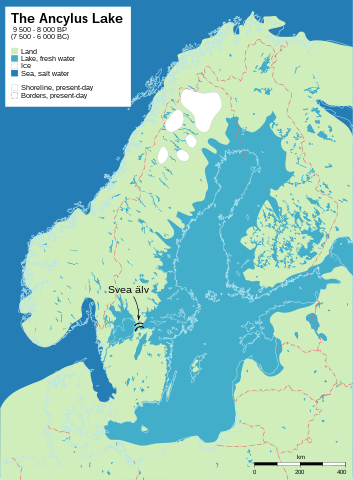
Ancylus Lake, design by Koyos (PD)
The first Finnish culture was Mesolithic Suomusjärvi-culture that is dated around 8500 - 5100 BCE. The first hunter-gatherers likely brought the dog with them. They knew how to fish with nets as one of the oldest nets in the world - Antrea net (around 8300 BCE) - has been found in former eastern Finland. During the years 7000 to 4000 BCE the climate was warm and resembled the climate of modern Germany.

The oldest known dwelling in Finland are goahti (hut/tent/tipe) types of buildings from the era of Suomusjärvi culture. They were most likely covered with either leather or birch bark.

Neolithic culture arrived to Finland around 5000 BCE. Buckwheat was first cultivated around 5300 BCE, but the cultural change followed only around 5100 BCE with the new Comb Ceramic Culture. This new culture was spread along the coast line of Anculys Lake (modern Baltic sea). After 4000 BCE climate started to cool down towards the modern temperatures.

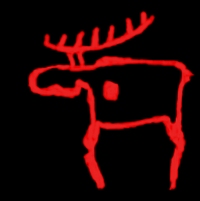
While people knew agriculture and ceramics, they were still mainly hunters and gatherers. They hunted especially moose, beaver and seals. Humans followed the game's movement with seasons. During neolithic era people living in Finland painted plenty of rock painting that have been interpreted to have had relationship with shamanistic world view. People bought flint stone from south. They used bows and arrows.

Kierikki ceramic around 3500-3200 BCE.
Photo by Bluefinland (Wikipedia, PD)
During this era, the first signs of square base buildings have been found. The walls may have been twisted of branches or post may have been used. There are some signs of log base and even use of interlocked logs. The fire places were very simple, a lot like camp fires or small stoves made of stones. They were usually located outside the buildings. The buildings were usually build along the coast line.

Corded Ware Culture spread to Finland from south around 3200-2900 BCE, which later spread to the area from modern Belarus to around Baltic sea. It was known for its stone axes that copied the style of copper ones. The culture was known for its habit of burying deceased to the single graves, men on their left and women on their right side.

In Finland there might have been conflict between Corded Ware and Comb Ceramic culture, when Corded Ware culture spread around the coastal area. The new people started to build huts, while people before had used tee pee type leather shelters. They may have brought cattle along them.

During the Corded Ware era the building were located little further from the coast than before, behind the coastal meadows. They were located so the feed for the cattle was close by. During the Kiukais Era the houses returned to the coast line.

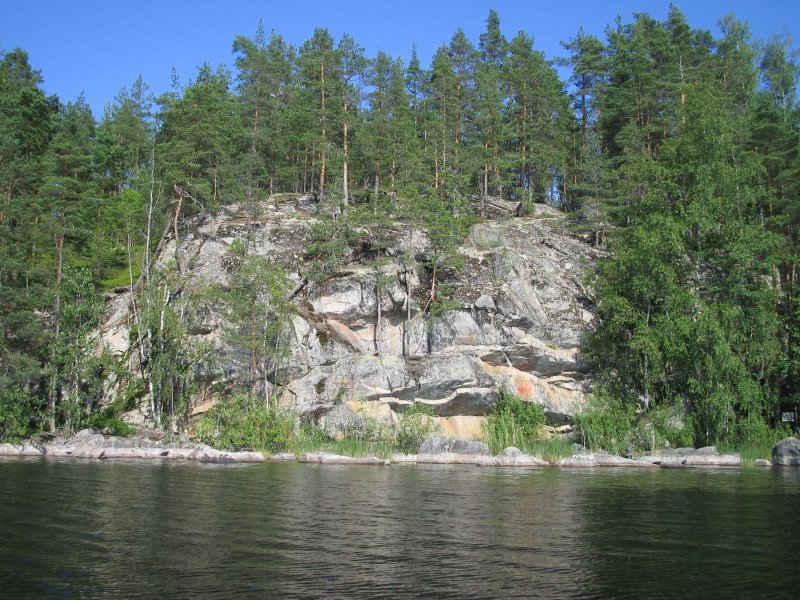
Rock painting from Astuvansalmi.
Around 2350-1800 BCE new local culture called Kiukais Culture was born. It had features of both Corded Were and Comb Were cultures. Maybe the more sever climate forced the people to unite. It is believed have been formed as a fusion of different cultures.

People certainly knew agriculture well. At least wheat, barley and oats were known. While the hunting and gathering was still very important, the slash-and-burn agriculture spread fast western and southern areas. The main livelihood was most likely fishing.

During the stone age people were mostly self-sufficient, but important tools and material were traded. The northern schist and eastern soapstone spread to the whole area. Flint was mainly imported from Russian, but southern Scandinavia as well. The chisels made of green shcist from Lake Onega area and knives and points made of Scandinavian red shcist were imported as ready-made tools. The asbestos from Savo area was traded during the manufacture of asbestos-ceramics.

Amber was imported from west and east. There has been also sembra wood ladles and runners found, most likely from Ural area. During the Corded Ware the internal trade was popular as well. The ceramics were made to trade and stone axes made of western Finnish olivine diabase spread to the whole area.

Many rock painting in Finland were made so they could
only be reached from boat or ice.
Photo by Lauri Kokkonen (PD).
The boats made of one piece of wood were probably common, although few have been found that can be pinned to the stone age. Paddles from comb ceramic era has also been found. The boats have been described in rock paintings. Some might have been decorated with a wooden moose heads. The boats made of planks might have been used, but first certain evidence of them are from iron age.

The sledges are one of the oldest findings in Finland and were used from the beginning of the stone age, probably pulled by dogs. The oldest skis found are from Comb Ceramic era. Earlies beautiful stone sculpture animal heads (f.e. moose and bear) date also from Comb Ceramic era. Ceramic, wooden and amber idols were known as well, although less fine quality.

Early Metal Ages

Finnish early metal age was around 1500 BCE - 200 CE. Around this era metal were known, the stone was still common material for everyday tools. There were two different cultures in coastal and inland areas.

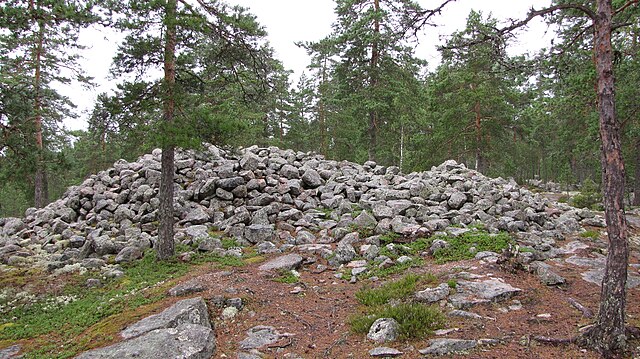
Bronze was known from around 1500 BCE. In the beginning, the4 main influences came from east. People knew how to make bronze, but most of the metal artifacts were brought from abroad. They were expensive and a sign of wealth. Only 150 metal artefacts have been found from Finland from this era. There were several different styles of ceramics known during the bronze age. Deceased were cremated and buried under stone piles.

Bronze age burial site in Sammallahdenmäki, Southwestern Finland,
UNESCO as a World Heritage Site. Photo by Roquai (PD, Wikimedia)

The culture was split in the western and eastern groups. In the west, the agriculture gained more significance, although hunting and gathering was still important. Most of the agriculture was still slash and burn. Cows, pigs, lamb and goats were kept and barley and wheat cultivated. The long houses were built like in Scandinavia. They were made between post and the walls might have been covered with either reed or turf. The houses might have been divided in two with the cattle in the other end. The floor might have been covered with flat stones.

In the east, the hunting and gathering was the main livelihood. Some barley was cultivated as side living. The main settlements were located along the water ways with good connections. Some were used for centuries from stone age to iron age. The housing might have been similar to the late stone age. Bronze casting was known, although most metal artefacts were imported. People had connected to the areas of Finno-Ugric populations in the East along the Volga and Oka rivers.

Some bronze age graves were looking for the Sea.
Photo by Pöllö - CC-BY-3.0
Culturally the era was peaceful unlike in the Southern Scandinavia, where the culture collapsed in the end of the era. In Finland, the transition to the iron age was gradual. When iron became to be known, the culture did not change much.

The first iron artifact arrived to Finland around 800-400 BCE. They came from both Scandinavian and Baltic areas and from northern Russian Ananjino Culture. People started to make iron artifacts both in the coastal and southern inland areas around 500-300 BCE. In the northern areas the iron making started around 300-200 BCE. The iron use is supposed to have spread slowly.

The earliest iron age in Finland is known as pre-Roman around 500 - 0 BCE. The iron was made from limonite found in lakes and bogs. In the coastal areas, the livelihood was based on seal hunting, fishing and agriculture. The graves were more modest than during bronze age. The coastal area was well connected to south to the Baltic area.

Upright pole based buildings were common during the whole iron age. The building was constructed between upright poles there were horizontally twined branches or split wood. The walls were clayed. Fireplace was in the middle of the floor. The outer walls might have been covered with turf.

Roman coins like this have
been found also in Finland.
CC BY-ND 4.0 by Turun Museokeskus
In the Early Roman Iron Age around 0 - 200 CE, few Roman artifacts spread to Finland. In this era the Romans had reached Danube and Rein and their strong influence reached northern Europe as well. The influences first reached the coastal areas. The inner land, so called Lake Finland was occupied mainly by hunters and gatherers. It is supposed that vivid fur trade to the southern areas is the source of wealth and continued long during the later iron age.

Burials in Southern Finland resembled the Estonian and Baltic ones, while the ones on the southwest coast were more like eastern Swedish. In the Ostrobothnia or mid- and northwest coastal area the old burial practices that had roots in the bronze age continued.

Later Roman Iron Age was in Finland around 200-400 CE. While the Roman power weakened, it was still important influence. In Finland in the Southern and South-Western coastal areas the metal objects were buried with deceased. In the coastal areas people were connected to both Baltic areas and Scandinavia as well as Finno-Ugric people in the mid-Russia. The rich burials tell about the birth of the class division. There was clearly a kind of upper class.

Middle and Late Iron Age

In the middle-Iron age the Roman power vanished. In the Migration Period of Europe (400-550/600) the agriculture spread from the coastal areas inward. There was more and more metal artefact in the graves and the weaponry resembled the ones of Germanic people. The Baltic style of jewelry is still well known. The oldest horse bit found in Finland are from this era. The first signs of cats are from middle-iron age as well.

Viking age building remake from Rosala
Photo by Pöllö - CC-BY-3.0
Rich grave finds relate to the social differentiation. Stone pile burial sites were formed around middle stone and the deceased were cremated. This period of iron age is archeologically relatively silent in inland and northern areas. This may be due to end of self-sufficiency in those areas.

During the Meroving period of Finnish iron age (550/600-800) vivid local culture is seen. There are a lot of archeological finds in south- and mid-western coastal area as well in the northern Häme area (Tavastia) called Pirkanmaa. The finest weapons were still imports. Jewelry was influenced from abroad, but locally modified to the taste. The local smithy was skillful. The foreign connections to Scandinavia, Western-Europe, Baltics and Finno-Ugric people in Russia, especially Permians were active. In the south-west and west coast agriculture was main source of livelihood, but in the inland areas the hunting and gathering was still important and fur trade might have been source of extra income.

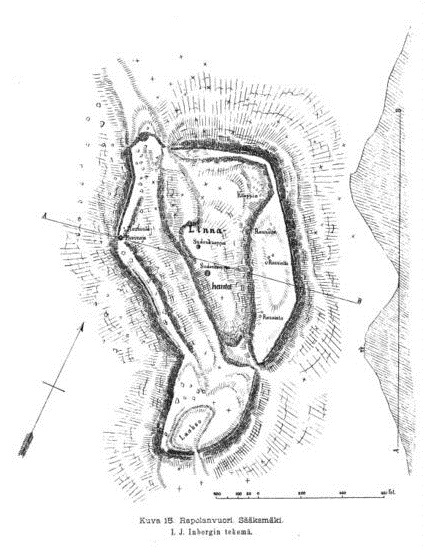
Rapola hill forth is one of the mightiest in Finland.
The old style of burial with cremation still remains in most areas, although burials are now made in the larger stone fields rather than single piles of stone. All though in certain areas of Satakunta new type of pit burial was used from around 500 onwards. This might be reflection of first influences from Christianity reaching Finland.

There is one mysterious burial site found from Leväluhta Southern Ostrobotnia were women and children (but no men) were possibly buried in the lake before it formed a bog. It differs from other bog burials as there are no signs of sacrificial violence. Animal bones were found and are supposed to be from provisions to the afterlife. Valuable crave gifts have also been found. The cremation usual to the era was not used.

In the younger iron age the new type of building, the log construction became common, although the roots of this building method were in the bronze age. The method of laying logs at intervals was used to make airtight buildings. In this era, the oven was placed on the corner of the building. The houses were covered with reed, straw, rods, birch bark or turf. The smoke was led out from the small hatch in the roof.

The Viking Era of iron age (800-1025/1050) was time of vivid foreign trade in Baltic Sea area. Early town like settlements were formed in many areas and silver was plenty. In the Viking era the demand of fur in Europe grew which brought new wealth to the area.

Karelian brooch from Iron age.
Similar horseshoe brooches were well known
in Finland during Viking and Crusade eras.
In Finland sword blades were often imported from Franks. The heavy bronze jewelry was typical for the era. The most popular ones were domed bronze brooches. Also, plenty of silver has been found. The cremation was no more used as the means of burial. Due to this more grave finds how been made. In the grave yard areas agriculture was now the main source of income. The chicken had become relatively common.

The population grew especially in the Savo and Carelian areas in the Eastern Finland. At the same time, it vanished from Ostrobotnia and Uusimaa areas in west and south coast for unknown reasons. It is possible that the coastal people moved inlands to protect themselves from the Viking attacks. In the same era, a lot of new village size hill forts were built. Few runestones found in Sweden tell Viking travels to Finland as well. Forntjot saga tells stories of Finnish and Kvenland kings, where the Kvenland is sometimes interpreted as Kainuu or Nothern Ostrobotnia, although they may tell about Sami people as well.

The first good evidence of clothing from Finland is from the Viking Era, although there are some scraps of fabric from the early iron age onward. The popular bronze spiral decorations in the clothing helped to save evidence in the graves. The popular bronze jewelry helped with the preservation of the fabrics as well. The main materials were wool and linen, although hemp and nettle was used as well. There are signs of imported fabrics like silk and Frisian broadcloth.

Typical vaulted bronze brooch from Viking Era.
CC-BY-ND 4.0 Mikkelin kaupungin museot
The women wore long undershirt covered with woolen peplos and linen apron and cape or shawl. There is evidence of headgear, woolen mittens and leather shoes as well. Men wore shirt, long jacket or tunic, cape, leg dressings and belts. Because men did not often use bronze in their clothing, we know much less of their appearance. Everyday clothing is not well known either, as it was normal to bury the deceased in their best wear.

The Crusade Era of iron age (1025-1300) the surrounding areas had mostly converted to cristianity.

During this era, the Scandinavian kingdoms were greedy for the influence in the east, where Novgrod was growing as the center of trade. In the center of this political contest was the Eastern Baltic sea area including Finland, Karelia and the Baltic countries.

The population grew, especially in Karelia and the agriculture was strong. The burials became immaterial ones. Finland was in the middle of the clash between eastern and western churches, that had split just 1054. Because of the unstable environment the hill forts became more and more important. New ones were build and old ones re-equipped. In the 12th century the first churches were built in the southwestern Finland.

Arrival of Christianity

12th century dress remake from Western
Finland. Photo by Daderot CC0 / PD
First crucifixies and other Christian symbols have been found from Finland date from the 10th century, but some influences can be seen on the graves from 7th century onwards. During the earliest influences crosses may have been used as amulets. Merchants may have used crucifixies to be able to trade with Christians. First influences arrived most likely with Christian merchants from surrounding areas.

Change in burial customs around year 1000 were the clear sign of strong Christian influences.  Also grave gifts vanished around the same time. Already during the Viking era Finns had started to bury deceased facing Easter sunrise. Around year 1000 most craves in south-western Finnish graveyards in Eura and Köyliä area faced the Easter sunrise, although the pagan believes are still seen living alongside new Christian ones.

Bishop Hilthius might have been missionary bishop in Birka in 11th century and responsible for Finnish mission. His responsibility were the Christians living east of Sweden. In the 11th century at least parishes of Kalanti and Laitila likely belonged to western church.  Officially Christianity arrived to Finland in 12th century.

Old legends tell that Christianity would have arrived to Finland by three crusades from Sweden. The first crusade was around 1150. The second most likely 1238 or 1239. The third and possibly the only real crusade was made to Carelia 1293. The Danish made at least two crusades to Finland around year 1200. Norwegians and Germans might have made their own crusades in the 13th century as well. The evidences of many of these crusades are lacking.

12th century dress from Eastern Finland.
The First Crusade at least is most likely legend or it might have been a plunder typical for the era that was later clorified. The mid-12th century was very violent in the Eastern Baltic were Swedes, Baltic Fennic people and Novgrod fought for the territories and influence. At least Novgorod chronicles tell about Swedish piracy. The only evidence is a story written in 1270s and other similar text from approximately the same era.

The Second Crusade might have been the first occupation of Finland by Swedes. According the Chronicle of the Lybeck Birger Jarl forced Finland to belong to Sweden. It was not a real crusade either, but more like a leidang-excursion. The excursion was directed to Tavastia also known as Häme, maybe to the harbor of Rikala, a coastal center or town in former Halikko municipality. The Chronicle of Erik that tells the story has been later seen as a political propaganda.

The Third Crusade 1293 was also described in the Eric Chronicles (written between 1320-1335). Duke Eric Magnusson, the hero of the chronicle and the brother of the king of Sweden, was the leader of the third crusade against Karelians. The motive was supposed to be the lootings by Karelians. The real motive was probably to conquer the area and gain an important trade post. The Castle of Vyperg was soon build as a strong hold in the site of former Karelian fortress.

Links to the Resources of Finnish History: